


Bookmark and Share

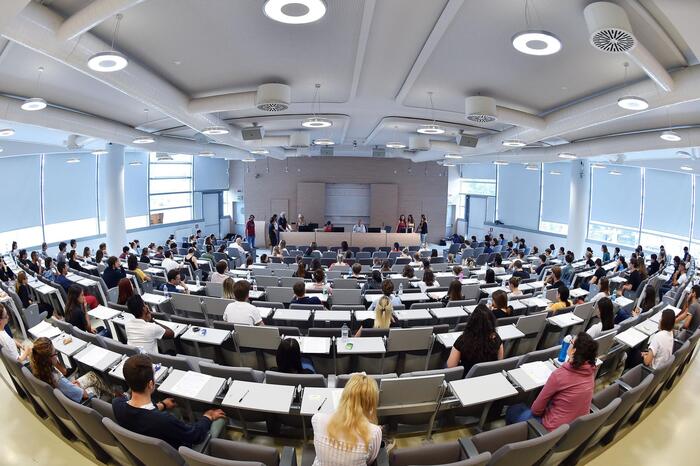
Thanksgiving break adds stress to finals

December 6, 2011
Bookmark and Share

We are using embedded Flash videos please update your Flash Player. If using a mobile device you can access content from a mobile download located below.


download Download Video:mobileweb

Video by Sarah Miller


Tags: , , , , , , , , , , , , , ,

Bookmark and Share

Mom and daughter share college experience

November 10, 2011
Bookmark and Share

PhotoHilary (left) and Jenn Swan look over some notes in their Spanish class at the University of Nebraska-Lincoln. The mother and daughter are enrolled in the same Spanish class.

Story and photos by Emily Nohr, NewsNetNebraska

Jenn and Hilary Swan have a lot in common.

The pair attends the University of Nebraska-Lincoln. They’re study buddies and sit next to each other in Spanish, the one course they share.

But they’re closer than friends — they are mother and daughter.

Twenty-two-year-old Hilary and her 49-year-old mom, Jenn, have been taking classes together since May when Jenn signed up for two summer session Spanish courses.

This fall, Jenn enrolled as a full-time student. She’s studying fine art with an emphasis in graphic design. Hilary, who is in her fourth year at UNL, is studying political science and global security.

They know their situation is different than most students on campus.

UNL doesn’t keep track of how many parents and children attend school at the same time. But Aaron Chambers, the pair’s Spanish professor, said he has never had a parent and child in a class before.

Other students often have something to say about the mother and daughter being in class together.

The first day they walked into Spanish class several months ago, they got some funny looks.

“‘Are you two sisters?’ is what a lot of people asked,” Hilary said with a smile.

She quickly corrected them.

“Nope. She’s just my mom.”

* * * *

Studying at UNL isn’t Jenn’s first experience at college.

After graduating from high school in Wyoming, Jenn moved to South Dakota and enrolled at Black Hills State University. But she wasn’t ready for college, she said. Instead of attending classes, Jenn hit the ski slopes during the week and socialized at night and on weekends.

“That was my priority,” she said.

Just a semester into classes, she dropped out.

Through the years, Jenn worked as an artist and photographer. But she never lost her desire to learn.

By the time she was married and already mom to Hilary, her only child, Jenn decided to try classes again, this time at the University of Wyoming.

Being a mom and taking classes wasn’t easy. Often, she’d lug a 6-year-old Hilary along to the classroom.

“There was a time I brought Hilary to an enormous gerontology lecture class with 300 people in it,” she said. “I didn’t raise my hand, but the professor said, ‘Yes?’ I looked down and Hilary had her hand up. She wanted to contribute to conversation.”

But that stint taking classes ended, too. And she never graduated.

It took the economic recession and a divorce to get back in the classroom, she said. And the third time at school has been positive.

“I love new. I love different,” she said. “I love to learn.”

Like her mom, Hilary bounced around colleges after graduating in 2008 from Grand Island Northwest High School. She started at Central Community College in Grand Island. After a year, she moved to Lincoln to try UNL. But it wasn’t quite what she envisioned, so she visited a culinary school on a weekend break.

Then Hilary thought long and hard about what she should do. Finally, she decided she’d stick out UNL for the remainder of the year.

She enrolled in several political science classes, hoping they would spark her interest.

They did.

Soon, Hilary and Jenn found themselves signing up for the same Spanish course.

“Why not?” they thought.

* * * *

As fall approached, Hilary had worried that students wouldn’t accept her mom. Their summer classes had been smaller, and they’d developed a close group of mutual friends. So they were relieved when several of those friends decided to take the same Spanish course this fall.

Other students, however, appeared to be worried about Hilary, assuming she would dislike the situation.

“Someone once said to me, ‘Your relationship with your mom is really weird. You guys hang out and like each other,’” Hilary said. “I said, ‘Well, what’s wrong with you and your mom?’”

In Jenn’s other classes, students avoided sitting by her for weeks. Still today, she gets discouraged when she doesn’t see other non-traditional, older students in her classes.

“I look around campus to see if there’s any older people who aren’t professors,” she said.

But most days, she doesn’t mind. She’s found a support system with some classmates.

“There was one day I was really struggling in class with an oral presentation,” she said. “When I was done, everyone clapped for me. It was awesome.”

* * * *

Jenn’s biggest worry about going back to school was making sure she didn’t affect her daughter’s class work and routine.

“I wanted to be really mindful that I wasn’t affecting (Hilary’s) college experience,” she said.

Hilary has never felt that way. In fact, there are few things she doesn’t like about her mom taking classes, too. She loves sharing similar stories and experiences from her day.

“I’ll be like, ‘Did you see that guy dressed up as Scooby Doo walking around campus today?’ And she’ll be like, ‘I saw that guy, too!’” she said.

Having Hilary in school makes Jenn more accountable, she said. The two often study together.

“We have the same work ethic and we’re serious students, but we can slack together like no other,” Jenn said, laughing.

The pair likes to have mother-daughter pedicure parties and make dinner occasionally during the week when neither of them are working at their part-time jobs. They live on opposite sides of Lincoln, but share custody of a 13-year-old mutt named Milly.

Their guilty pleasure is watching Jersey Shore together.

In Hilary’s apartment hangs a plaque her mom gave her. It reads, “I’d rather do nothing with you, that anything with anybody else.”

That saying sums up their relationship, Jenn said.

“I do love her, but I like her, too.”

Photo


Tags: , , ,

Bookmark and Share

UNL appears on annual magazine’s list

September 20, 2011
Bookmark and Share

Photo
Students sit by fountain at the University of Nebraska-Lincoln.

Photo byAlia Conley, NewsNetNebraska
Story by Alia Conley, NewsNetNebraska

The University of Nebraska-Lincoln made several lists on U.S. News and World Report’s annual Best Colleges list. U.S. News uses 15 academic indicators, such as ACT scores, class rank, graduation and retention rates and financial resources, to rank the schools. Some of the important highlights:

  • UNL tied with seven others at No. 101 on the general “Best Universities” list. That’s an improvement from last year’s rank at No. 104.
  • The UCARE program, Undergraduate Creative Activities and Research Experiences, is featured on a list along with 28 other undergraduate research programs. For the first year, UNL made the list of schools that “get the nod for programs that help undergrads thrive.”
  • UNL made the new “A-Plus Schools for B Students” list, which focuses on non-high school superstars who can go to a great college and succeed.
  • UNL appeared on the “Least Debt” list, with 60 percent of graduates who have an average debt of $16,664.

Craig Munier, the director of the Office of Scholarships and Financial Aid for UNL, said students are borrowing about one-fourth of their total college costs  – a reasonable amount to pay off.

“We’re below the national average for graduate debt for public four-year universities of our type. UNL is very affordable.”


Tags: , , , , , , ,

Bookmark and Share

Outside the wedding bell curve

July 6, 2011
Bookmark and Share

Story and graphics by Lauren Vuchetich, NewsNetNebraska

“I never saw myself getting married in college but I love being married while in school,” Lauren Honeywell said. “It’s so good to come home to some stability, it’s a constant in my life.”

“We talked about marriage really early on, we saw ourselves together in the future right from the get-go, we kind of just made the mutual decision we would get married then went with it,” Honeywell a UNL family sciences major said.

Honeywell met her husband, Joshua, through a campus ministry group and eight months later they were engaged. “Then three months after that we were married.”
The National Center for Health Statistics found that about 60 percent of couples who get married at ages 20 and 25 are will get divorced. That’s 10 percent higher than divorces that occur between couples who marry at the average age or older.

“Generally, the younger you get married, the more likely you are to get a divorce. There are several variables to this, maturity, financial security,” Shala Hruska an intern for Nebraska Health an Human service said.

The National Marriage Project of the University of Virginia states that
one of the main struggles young couples run into life experience and emotional immaturity.

Honeywell acknowledges these struggles, “Getting married young also means that we are still in the egocentric line of thinking, so you have to be extra intentional about sacrificing which is hard because at times I only think that the way I am affected is important.”

Many college students don’t have a solid plan for their future, but the average American 26-year-old is (the average age of marriage) is more likely to have a firm idea of their future.

“The average of age of first marriage has been pretty consistently related to college graduation for quite some time. I do think young couples want to be more financially stable and settled within their career before they marry,” Sheree Moser a University of Nebraska-Lincoln family sciences professor said.

“Marrying older you are more settled and constant. You are more
likely to have an established career,” Hruska said.

Honeywell said that married life can be yet another excuse to procrastinate in college. ” It’s hard with work, homework, class, church and socializing. I’m really trying to learn how to be more intentional.”

One of the things that has been shown to strengthen marriages is common memories that a lot of young couples haven’t yet developed. Honeywell said she and her husband are very careful about making time for each other to strengthen their bond.

“Being married under the average age doesn’t have to be a scary thing,” Honeywell said not all young love should lead to young marriage, “Just because some people get married young doesn’t mean that it’s right for everyone.”

Data gathered from cdc.gov.

To beat the statistic of high Moser says pre-marital preparations should include counseling, an act that has proven to help marriages last longer, “The longer the pre-marital counseling, the lower the rate of divorce so I would recommend any couple getting ready to marry to get involved with some kind of counseling or therapy.”
“I taught a ‘Relationships’ class at Lincoln High for 20 years and we studied everything about the characteristics that would help make relationships strong and positive throughout life. I think the most important thing people need to remember is that any long-term relationship requires working on it from both of the parties,” Moser said. “If that means going to pre-marital counseling, then it should not be too much of a sacrifice considering the investment in a life partner. Work includes communication, honesty, trust, loyalty. All of the character traits that are common to any good relationship.”

Moser says the mentality toward marriage has changed in recent years and may have to do with younger people’s decision to marry, “One of the new concepts in the marriage literature that scares me is the ‘starter marriage’, a first marriage that lasts fewer than 5 years and produces no children. It’s almost like there is a ‘do-over’ attitude contrary to the commitment level that should be involved in a union that is promised to be life-long.


Tags: , , ,

Bookmark and Share

Flag Football League Provides Outlet For Local Athletes

December 8, 2010
Bookmark and Share

Photo
Players from the Omaha branch of the NFFL playing a game.

Story and Video By Josh Compton, News Net Nebraska, Photos Courtesy of the Nebraska Flag Football League

When Nick Gregath started the Nebraska Flag Football League in 2006, he didn’t know what to expect. He knew that his immediate friends would be interested, but what he didn’t know was how much the league would grow over the coming years.

“My friends and I were sitting around and decided that we should start a flag football league,” said Gregath, the 29-year-old owner of the NFFL. “I bought all of the equipment, put up a bunch of posters, and just sat back to see what would happen.”

In its first year, Gregath welcomed 31 teams to the league. Today, 75 teams and a total of over 600 players are currently members of the NFFL. Most of the players are in their mid-20s and live in Lincoln, Neb. For them, the league is all about fun, friends and a little bit of exercise.

“It’s an excuse to run around on a Sunday,” said Cody Wehrkamp, a NFFL team member and laboratory technician at the University of Nebraska-Lincoln. “Plus, it feels really good to win.”

Wehrkamp said that his team is competitive but that his team doesn’t spend time creating playbooks or practicing like some of the other teams.

“We don’t practice,” said Wehrkamp. “The quarterback just draws up plays in huddle. It isn’t really formal or structured.”

Photo
The NFFL website tracks team and player stats which are updated after each game and verified by team captains.

Others play for the camaraderie and the chance to keep up the skills they learned in high school or college.

“I’ve always liked the sport and my best friend actually got me on the team,” said Micah Busboom, a student at Southeast Community College in Beatrice. “Up until I was a freshman in high school, I was a quarterback and played a little defense. It’s just fun to get back out on the field.”

Gregath knew that creating a flag football league wasn’t an original idea. He played for Run-N-Gun, a now-closed league that was located in Omaha. But Gregath also knew that interest in the league wouldn’t be a problem, as many college graduates hoped to replace intramural flag football with a city-wide league. His worry was how he could sustain the NFFL without charging too much and scaring potential teams away.

“People don’t understand that the city won’t just let you play,” said Gregath. “You have to buy insurance and you have to rent the fields.”

Gregath decided to charge $375 per team to help pay for city fees and player uniforms. Each team must also pay $15 per game to the referee. It’s this system that has helped Gregath keep the league going and ensure that it can stay in place for years to come.

The NFFL is split into two divisions. One is called Competitive and is designed for teams that have a high amount of athletic talent. The other is called Intermediate and is for teams with a moderate amount of athletic talent but aren’t as worried about wins and losses. The year is split into two seasons, Fall and Spring, and Gregath said that most teams play in both.

Photo
Players from the Omaha branch of the NFFL getting ready to play a game.

Teams play 10 or 11 regular season games in order to be seeded for playoffs at the end of the year. Each division awards a cash prize to its champion ($1,000 for Competitive and $200 for Intermediate).

Gregath and the players are happy to keep the NFFL local. Gregath said he could have given the league national and international attention by teaming up with FlagMag.com, a website that ranks flag football teams from all over the United States and a few other countries as well. He decided against it as it would mean teams would have to incur additional fees.

Gregath did decide to expand the league into Omaha, which includes a division that’s open to both men and women, in addition to the Intermediate and Competitive ones, and handed those operations over to his friend, Wyatt Godfrey, but he doesn’t see any further growth. Instead, he sees the NFFL maintaining its current size and focusing on being a fun, flag football organization for the local community.

“I started the league because my friends and I wanted to play football,” said Gregath. “I keep it going because I know that a lot of other people want the same thing.”

We are using embedded Flash videos please update your Flash Player. If using a mobile device you can access content from a mobile download located below.

download Download Video:mobileweb


Tags: , , , , , , , , , ,

Bookmark and Share

UNL freshmen experience change

September 14, 2010
Bookmark and Share

Photo

Freshman Mackenzie Wiley looks down upon the Lincoln downtown a few days after arriving at the University of Nebraska-Lincoln.

Story and Photo by Patrick Breen
NewsNetNebraska

Mackenzie Wylie kicked her parents out of her dorm room at noon on her University of Nebraska-Lincoln move in day.

“They were devastated,” she said. “They cried.”

But Wylie, a freshman journalism major, showed little emotion saying “I was just ready for college. I was sad for a second, then I moved on.”

Despite walking in to a relatively unknown situation, Wylie, an 18-year-old Kansas native, just wanted college to start. And with the growing use of technology, students are finding it easier to move away with less pain of missing their parents.

Cutting the umbilical cord and going to college used to mean severing ties with your parents for months at a time. But with a generation that has become notoriously well-known for its cordless technology, staying in contact has eased the burden on students and parents separating.

“I told them I wasn’t going to be home for Thanksgiving,” Wylie said, “but I do talk to my mom every day.”

From text messages to e-mails, parents are never more than a few clicks away, and that makes it easier for students to not miss their parents.

“It’s nice to be able to just send a text to say how I’m doing,” freshman Matthew Masin said.

Masin said he didn’t think to much about his parents leaving because he knew he could still talk to them anytime.

Still, first year graduate psychology student Lixin Ren said that being away from your parents changes nearly everything. Ren, who specializes in parent-child relationships, said that leaving a family member, whether a parent leaving a student, or a student leaving a parent, cause the whole social situation to change.

Parents often feel as if their child is gone forever, she said. They express emotion more openly and often feel more anxiety than the child.

“It’s tough for them,” Ren said. “I know my parents miss me.”

But going to college brings about some common fears for students, too. When Wylie moved into her dorm she said she didn’t know many people and sometimes felt lonely.

Ren said this feeling was common for students and said that anytime a person switches into a new situation, fear and isolation can cause stress.

“They had their parents always at home,” she said. “Not now.”

The stability of having parents at home allowed for the children to become accustomed to them being there, and transition time must be allowed in college.

Despite the boom in technology, other fears exist.

“I remember (three years ago) not knowing where anything was the first week and thinking the campus was huge,” senior arts and graphic design major Breana Huff said.

Some freshmen leave boyfriends and girlfriends back home. Whether they are still in high school or have gone to different colleges themselves, the separation from those close friendships is difficult.

Wylie left her boyfriend of a year and a half, back in Kansas. She said it was tough not having him around. But Wylie said that the technology like texting, Facebooking and calls has made it easier for the two.

Forging new relationships and friendships takes time in college, Ren said, and it is even tougher for students of different backgrounds. Students like herself, studying abroad have grown up differently, like herself she said.

“People have different childhoods, education, (and) backgrounds,” Ren said.

Ren graduated from The Chinese University of Hong Kong and is getting her doctorate in psychology at UNL. She has been in Lincoln for just over two months.

“It’s hard (to) be isolated,” she said. “(But it) gets better and better everyday. Students do activities and come together.”

Masin said he didn’t have many fears about coming to college, but definitely has noticed the change.

“It just feels different,” he said. “I can’t describe it.”

Huff said she remembered the feeling and that, with time, college just becomes the norm. She said the freshmen will be “so engulfed by classes that they won’t have time to miss their parents.”

Ren said that the cure to homesickness and loneliness could be cured easily and without medicine.

“It just takes time,” she said. “It will get much better.”

And now that the first few weeks of college have passed for UNL’s 6,785 freshmen, the normality of going home to their dorms is becoming more routine.

“It’s starting to feel like home,” Masin said. “I no longer need a map.”


Tags: , , , , , , , ,

Bookmark and Share